Learning the Universe: The Structure of Dust Attenuation Curves in Galaxy Simulations
Published in ApJ, 2026
Recommended citation: L. Sommovigo, D.J. Bartlett, R.K. Cochrane, M. Ho, C.C. Lovell, R.S. Somerville (2026). "Learning the Universe: The Structure of Dust Attenuation Curves in Galaxy Simulations." ApJ 1008 218.
Abstract
Dust attenuation is a major source of systematic uncertainty in both SED fitting and forward modeling of galaxy populations, yet the functional form used to parameterize attenuation curves has received surprisingly little systematic scrutiny. Particular unanswered questions include: how many free parameters are genuinely needed, and which analytic expression best captures the full diversity of attenuation curve shapes in galaxies across cosmic time? Using a large library of synthetic attenuation curves from TNG50 and TNG100 galaxies post-processed with the SKIRT radiative transfer code using three dust mixtures (Milky Way, SMC, and stellar dust), we show via Information-Ordered Bottleneck analysis that exactly four parameters are needed to capture the diversity of attenuation curves. Guided by this result, we use symbolic regression to derive a new, interpretable four-parameter attenuation model that outperforms existing parameterizations in recovering both attenuation curves and emergent fluxes across all dust mixtures explored. The four parameters of this model have clear physical interpretations: UV bump strength, FUV slope, UV-bump transition curvature, and large-scale optical slope. Their correlations with galaxy properties are primarily regulated by star-formation rate surface density, metallicity, and stellar–dust geometry, and are largely preserved across dust mixtures – except for the bump-sensitive parameters, which retain a stronger dependence on grain composition. We further provide symbolic-regression scaling relations linking all four parameters to quasi-observable galaxy properties, offering a physically motivated route to assign realistic attenuation curves in SED fitting and forward modeling without radiative-transfer calculations.
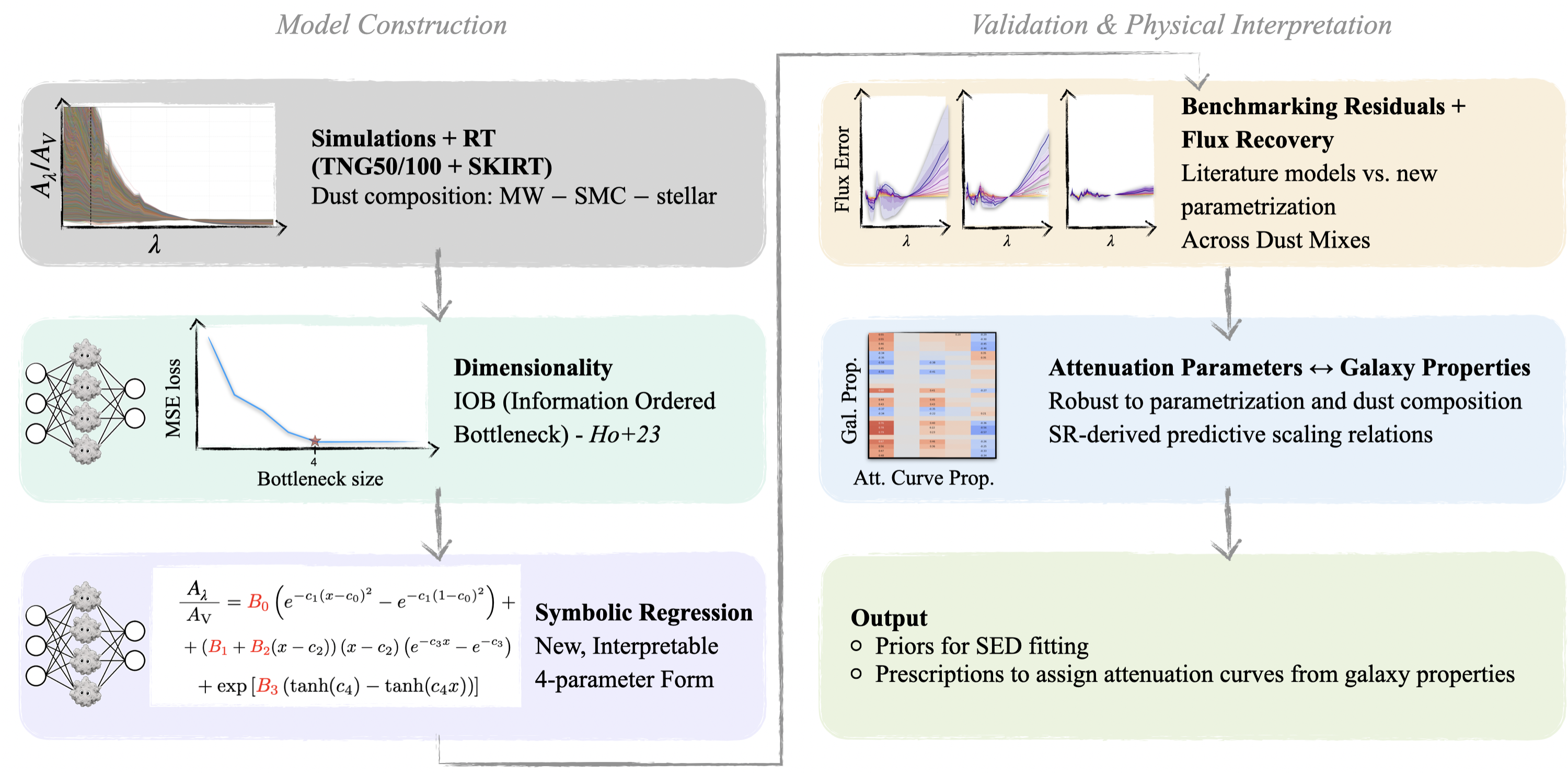 Schematic overview of the methodology and main results of this work.