<?xml version="1.0" encoding="utf-8"?><feed xmlns="http://www.w3.org/2005/Atom" ><generator uri="https://jekyllrb.com/" version="3.10.0">Jekyll</generator><link href="https://deaglanbartlett.github.io/feed.xml" rel="self" type="application/atom+xml" /><link href="https://deaglanbartlett.github.io/" rel="alternate" type="text/html" /><updated>2026-07-10T17:29:03+02:00</updated><id>https://deaglanbartlett.github.io/feed.xml</id><title type="html">Dr. Deaglan Bartlett</title><subtitle>Postdoc at the IAP</subtitle><author><name>Deaglan Bartlett</name><email>deaglan.bartlett@physics.ox.ac.uk</email></author><entry><title type="html">Learning equations from data how to choose the best function</title><link href="https://deaglanbartlett.github.io/priors-sr/" rel="alternate" type="text/html" title="Learning equations from data how to choose the best function" /><published>2023-08-11T00:00:00+02:00</published><updated>2023-08-11T00:00:00+02:00</updated><id>https://deaglanbartlett.github.io/priors-sr</id><content type="html" xml:base="https://deaglanbartlett.github.io/priors-sr/"><![CDATA[<p><a href="https://link.growkudos.com/1q06by4hkw0">Read the Kudos article here</a></p>]]></content><author><name>D. Bartlett</name></author><summary type="html"><![CDATA[If we truly are to automate the scientific process of converting data to equations, we want our algorithms to suggest candidate expressions which a human could have plausibly written down. In this work we compare Bayesian and MDL methods for achieveing this and apply our methods to benchmark problems and a real-world application from cosmology.]]></summary></entry><entry><title type="html">Constraining dark matter annihilation and decay in large-scale structures</title><link href="https://deaglanbartlett.github.io/method/observations/flat-dm/" rel="alternate" type="text/html" title="Constraining dark matter annihilation and decay in large-scale structures" /><published>2022-06-19T00:00:00+02:00</published><updated>2022-06-19T00:00:00+02:00</updated><id>https://deaglanbartlett.github.io/method/observations/flat-dm</id><content type="html" xml:base="https://deaglanbartlett.github.io/method/observations/flat-dm/"><![CDATA[<p>The identification of dark matter is a crucial task of modern physics. We present a full-sky, field-level search for dark matter annihilation and decay in the large-scale structure of the nearby universe, exploiting more information than conventional analyses targetting specific objects. We find no evidence for such effects, placing new constraints on the rates of dark matter interactions.</p>

<h1 id="background">Background</h1>

<p>Dark matter makes up ~25% of the universe’s mass and is the key component
in structure formation. Our knowledge of dark matter currently comes solely from its
gravitational influence, but revealing its particle nature will require
identifying its other interaction with itself and standard model particles.
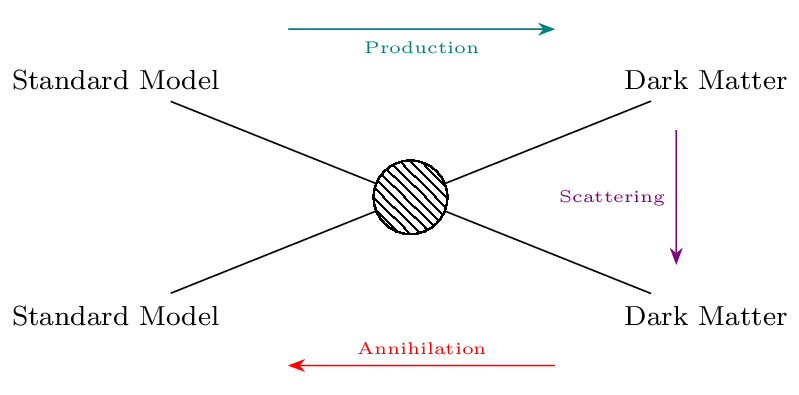
Fig 1 shows the three processes that such interactions would allow: production
of dark matter through collision of standard model particles, scattering between dark matter and standard model particles,
and annilihation of dark matter into standard matter particles. Each of these has an associated
detection method: we could produce dark matter in particle colliders (“direct
detection”), see recoils of standard model particles due to incident dark matter (“scattering”), or
identify standard model particles produced by dark matter annihilations (“indirect detection”). A
final possible interaction, included in “indirect detection” but involving only
a single dark matter particle, is the spontaneous decay of dark matter into standard model particles.</p>

<p><img src="/assets/posts/flat_dm/Fig1.png" alt="Interaction of dark matter with Standard Model particles" />
<em>Cartoon illustrating the ways in which dark matter may interact with Standard Model particles.</em></p>

<p>We are concerned here with dark matter annihilation and decay. This is typically sought
by identifying astrophysical objects whose kinematics indicate that they are
particularly dark matter-rich, which include the Milky Way, dwarf spheroidal galaxies
(dSphs) in the Local Group and massive clusters further afield. One then targets
these objects with telescopes sensitive to gamma-rays, which the standard model particles
produced by dark matter would be expected to decay into. These searches have enabled us
to rule out a thermal relic origin for WIMP dark matter at low mass, depending
on the annihilation channel. Such methods however have two important
disadvantages:</p>

<ol>
  <li>by focusing on specific objects they necessarily miss gamma-rays coming from the interactions of any dark matter not in the objects,</li>
  <li>they are susceptible to systematic errors due to gamma-rays produced in those objects by non-dark matter, i.e. baryonic, means.</li>
</ol>

<p>To avoid these potential pitfalls, we instead forward-model the gamma-ray flux
from annihilation and decay pixel-by-pixel across the full sky using BORG-based
models of the large-scale dark matter distribution. This enables a field-level
inference of annihilation and decay rates on comparison with similarly all-sky
data from the Fermi Large Area Telescope.<sup id="fnref:paper" role="doc-noteref"><a href="#fn:paper" class="footnote" rel="footnote">1</a></sup></p>

<h1 id="predicting-annihilation-and-decay-fluxes">Predicting annihilation and decay fluxes</h1>

<p>Our method leverages CSiBORG, a suite of 101 high-resolution
N-body simulations with initial conditions spanning the posterior of the 2M++ BORG-PM
chain. Each box provides a plausible realisation of the dark matter distribution
out to ~200 Mpc, including the clumping of dark matter into halos. We use this to make a
prediction for the annihilation (decay) flux that would be seen for each line of
sight on the sky for a given annihilation cross-section (decay rate) and
channel, which we then project onto a Healpix grid to match the resolution of
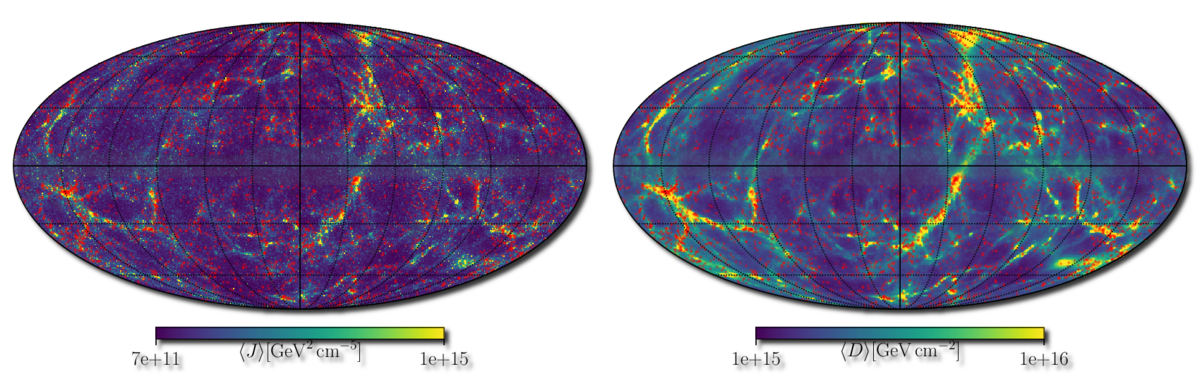
Fermi. This is shown in Fig 2, in terms of the “J-factor” (left) and “D-factor”
(right) that describe the astrophysical contributions to the flux (i.e. without
the particle physics terms). Assuming a Poisson likelihood for the measured flux
in each pixel, and marginalising over the CSiBORG realisations, a model for
substructure within each halo and a set of templates that describes the
contribution from non-dark matter sources, we constrain the parameters of dark matter interactions
using all nearby dark matter that is resolved by CSiBORG.</p>

<p><img src="/assets/posts/flat_dm/Fig2.png" alt="Map of J and D factors" />
<em>Full-sky Mollweide projection in galactic coordinates of the ensemble mean J and D factors over the CSiBORG realisations. These are proportional to the gamma-ray flux produced by dark matter annihilation and decay respectively.</em></p>

<h1 id="bounding-dm-interactions">Bounding DM interactions</h1>

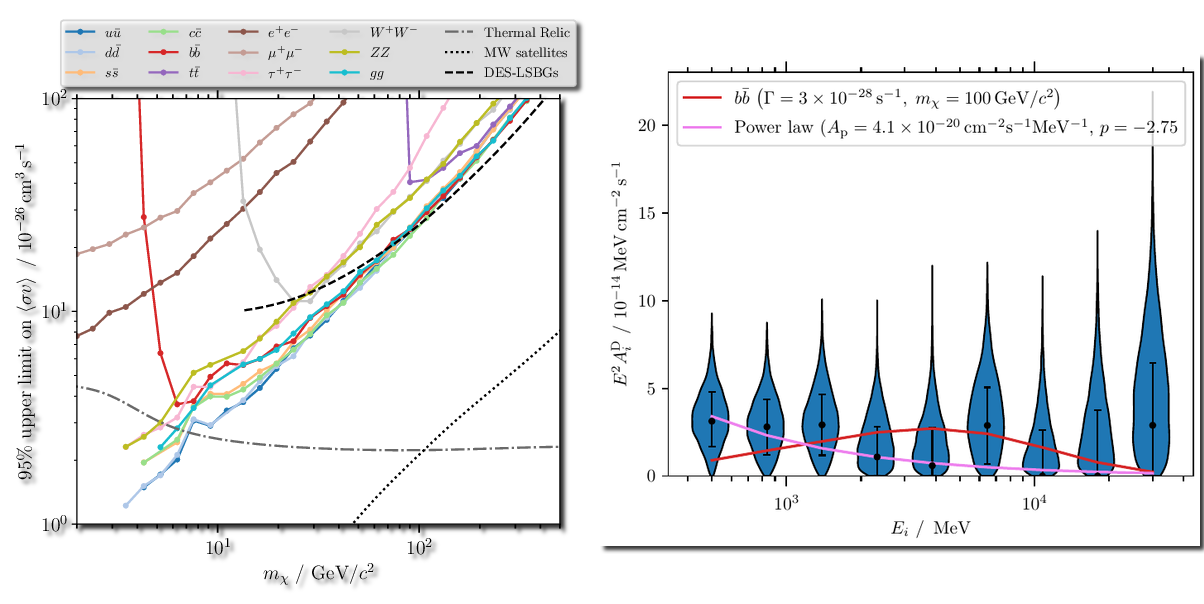
<p>We find no evidence for enhanced gamma-ray flux tracing dark matter density squared, as
would be expected in an annihilation model. This allows us to set constraints on
the cross-section, which we show in Fig 3 (left) as a function of dark matter particle
mass for a range of different annihilation channels. The grey dot-dashed line
shows the thermal relic cross-section, which is the value needed to explain the
current dark matter abundance through thermal freeze-out in the early universe
(the standard production mechanism for WIMPs). Locations where bounds are below
this indicate that the thermal relic scenario is ruled out. The black dashed
line shows a previous constraint from cross-correlation of gamma-ray flux with
the positions of low surface brightness galaxies, and the dotted line is from
dSphs in the Local Group. While these constraints are much stronger than ours
as dSphs are very close leading to large predicted flux (not included in our
analysis because they are below the CSiBORG resolution limit), they are
sensitive to flux contributions from baryonic processes. In our approach,
significant constraining power comes from regions largely devoid of baryons
such as the filaments that connect halos.</p>

<p>The right panel of Fig 3 shows our constraint on the flux due to dark matter decays,
separately for each of Fermi’s energy bins. That many are centred away from zero
indicates that we do detect gamma-rays with a flux distribution across the sky
that traces the dark matter density, as expected for decays. However, the spectrum of the
signal is much more closely aligned with a power-law than the expectation from
decay (pink vs red line), suggesting a more mundane, baryonic origin such as
blazars.</p>

<p>In conclusion, we have used BORG to open yet another field – dark matter indirect
detection – to full-sky, field-level Bayesian inference. In principle this
allows all the information to be extracted from gamma-ray surveys and thus
represents the most promising astrophysical method for uncovering the
non-gravitational interactions of dark matter.</p>

<p class="figure wide whitebg"><img src="/assets/posts/flat_dm/Fig3.png" alt="Derived constraints" />
<em>Left: 2\(\sigma\) bounds on the dark matter annihilation cross-section for various different channels (coloured lines). The grey dot-dashed line is the cross-section of a thermal relic WIMP, and the black dashed and dotted lines show literature constraints from galaxy cross-correlations and Local Group dwarf spheroidals respectively. Right: Flux contribution with the spatial distribution expected from dark matter decay in each Fermi energy bin. The red line is the spectrum expected from decays to \(b\bar{b}\), while the pink line, preferred by the data, is the best-fit power-law spectrum.</em></p>

<div class="footnotes" role="doc-endnotes">
  <ol>
    <li id="fn:paper" role="doc-endnote">
      <p>D. J. Bartlett, A. Kostic, H. Desmond, J. Jasche &amp; G. Lavaux, 2022, <em>Constraints on dark matter annihilation and decay from the large-scale structure of the nearby universe</em>, Phys Rev D submitted, <a href="https://arxiv.org/abs/2205.12916">arXiv:2205.12916</a> ![arxiv] <a href="#fnref:paper" class="reversefootnote" role="doc-backlink">&#8617;</a></p>
    </li>
  </ol>
</div>]]></content><author><name>D. Bartlett</name></author><category term="method" /><category term="observations" /><summary type="html"><![CDATA[The identification of dark matter is a crucial task of modern physics. We present a full-sky, field-level search for dark matter annihilation and decay in the large-scale structure of the nearby universe, exploiting more information than conventional analyses targetting specific objects. We find no evidence for such effects, placing new constraints on the rates of dark matter interactions.]]></summary></entry><entry><title type="html">Is the speed of light energy dependent?</title><link href="https://deaglanbartlett.github.io/method/observations/quantum-gravity/" rel="alternate" type="text/html" title="Is the speed of light energy dependent?" /><published>2021-11-06T00:00:00+01:00</published><updated>2021-11-06T00:00:00+01:00</updated><id>https://deaglanbartlett.github.io/method/observations/quantum-gravity</id><content type="html" xml:base="https://deaglanbartlett.github.io/method/observations/quantum-gravity/"><![CDATA[<p>High energy astrophysical transients at cosmological distances allow us to
test the fundamental assumptions of the standard models of cosmology and
particle physics, such as the Weak Equivalence Principle, Lorentz Invariance
or the massless nature of the photon. A violation of any of these would result
in energy-dependent arrival times for photons from distant sources. We forward
model these time delays for gamma ray bursts using the BORG SDSS-III/BOSS
reconstruction and compare to data to constrain the quantum gravity energy
scale, the mass of the photon, and violations of the Weak Equivalence Principle.</p>

<h1 id="overview">Overview</h1>

<p>A fundamental assumption in our current theories of the Universe is that photons
always travel at the same speed, \(c\), independent of their energy. But this needs
not be true. If the photon had a non-zero rest mass, then lower energy photons would
travel slower (\(v &lt; c\)). Alternatively, it is expected that quantum fluctuations
of spacetime at high energies in so-called quantum gravity (QG) theories would make
spacetime appear “foamy”, and thus empty space would have an energy-dependent
refractive index. Or perhaps photons of different energy couple to gravity with
different strengths (and thus violate the weak equivalence principle), so that photons
of different energy travel differently through a gravitational field. In any one of these
cases, photons of different energies from a distant source would arrive at different times,
even if they were emitted simultaneously. Since the expected time delay increases with
distance travelled, by studying the energy-dependent arrival times (spectral lag) of photons
from sources at high redshift, we can place tight constraints on the quantum gravity length scale,
\(\ell_{\rm QG}\), the photon mass, \(m_\gamma\), or the different couplings of photons
to gravity at different energy, \(\Delta \gamma\). The high redshifts and short durations
of Gamma Ray Bursts (GRBs) are ideal for this, so this is what we consider here. For the
majority of Gamma Ray Burts, high energy photons are detected before lower energy photons, which is
qualitatively the same as for a massive photon and some quantum gravity models,
and could thus provide evidence for such theories.</p>

<h1 id="the-gravitational-time-delay">The gravitational time delay</h1>

<p>To constrain the equivalence principle, we must be able to predict how long it takes a
photon to travel through a gravitational field. The resulting time delay to a distant source
depends on the gravitational potential along the path that it travels and thus depends on the
direction in the sky. If one had knowledge of the true present-day matter field, then one could
create maps of the expected time delay as a function of source position. Indeed, in previous
attempts to constrain equivalence-principle violation, \(\delta \phi\) was modelled as arising
from one or a few isolated sources near the line of sight, however the long range of gravity
casts doubt on the multiple point masses approximation. Instead, we account fully for the
contributions to the time delay from all mass in the non-linear cosmological density field. We
derive the contribution from local structures using constrained density fields generated by the
BORG reconstruction of SDSS-III/BOSS <sup id="fnref:1" role="doc-noteref"><a href="#fn:1" class="footnote" rel="footnote">1</a></sup>, and combine this with an unconstrained contribution from
distant sources to produce a Monte-Carlo based source-by-source forward model for the expected
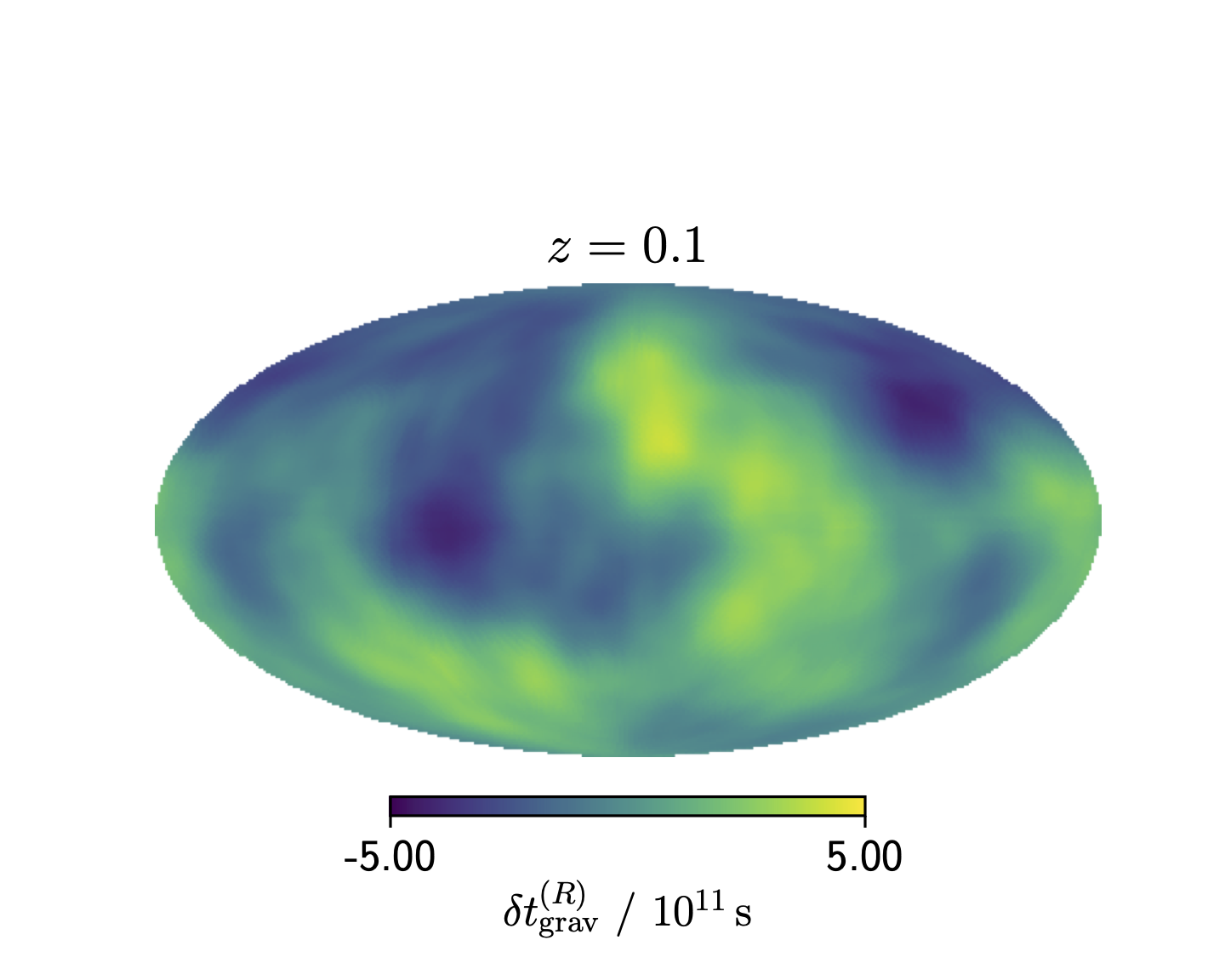
time delay. The ensemble mean of the resulting time delay fluctuation map is plotted in Figure 1,
and is \(\sim 10^{11} {\rm \, s}\) for a source at \(z=0.1\).</p>

<p class="figure"><img src="/assets/posts/quantum_gravity/fluctuation_plot.png" alt="Shapiro time delay map at redshift 0.1" />
<em>Mollweide projection in equatorial coordinates of the ensemble mean of the time delay fluctuations at \(z=0.1\) from wavelengths resolved by the BORG reconstruction.</em></p>
<h1 id="forward-modelling-the-time-delays">Forward modelling the time delays</h1>

<p>We use a catalogue of 668 Gamma Ray Bursts for the BATSE satellite since these not only have spectral lag
data, but also pseudoredshifts calculated using the spectral peak energy-peak luminosity relation.
Propagating uncertainties on the pseudoredshifts, sky localisation and spectral parameters through
Monte Carlo Sampling, we produce source-by-source forward models for the likelihood of a time delay
from quantum gravity, a photon mass or equivalence principle violation. However, these are not the
only types of physics that can lead to spectral lags: these may also be generated through intrinsic
differences in the emission of photons of different wavelength at the source or their propagation
through the medium surrounding the Gamma Ray Burst, or through instrumental effects at the observer. Without a
robust physical model for the time delays these lead to, we model them using a generic functional form
(a sum of Gaussians) with free parameters that we marginalise over in constraining \(m_\gamma\),
\(\ell_{QG}\) and \(\Delta\gamma\). We vary the number of Gaussians used to describe these observational
and astrophysical processes to find the best-fitting model to the data. Importantly, we find that our
results are insensitive to this choice; a vital check that was often neglected in previous work. We
compare our predicted time delays to the observed ones through a MCMC algorithm and therefore constrain
\(m_\gamma\), \(\ell_{QG}\) and \(\Delta\gamma\).</p>

<h1 id="is-the-speed-of-light-energy-dependent">Is the speed of light energy dependent?</h1>

<p>We find no evidence that the speed of light has an energy dependence. We constrain the photon mass to
be \(m_\gamma &lt; 4.0 \times 10^{-5} \, h \, {\rm eV}/c^2\) and the quantum gravity length scale to be
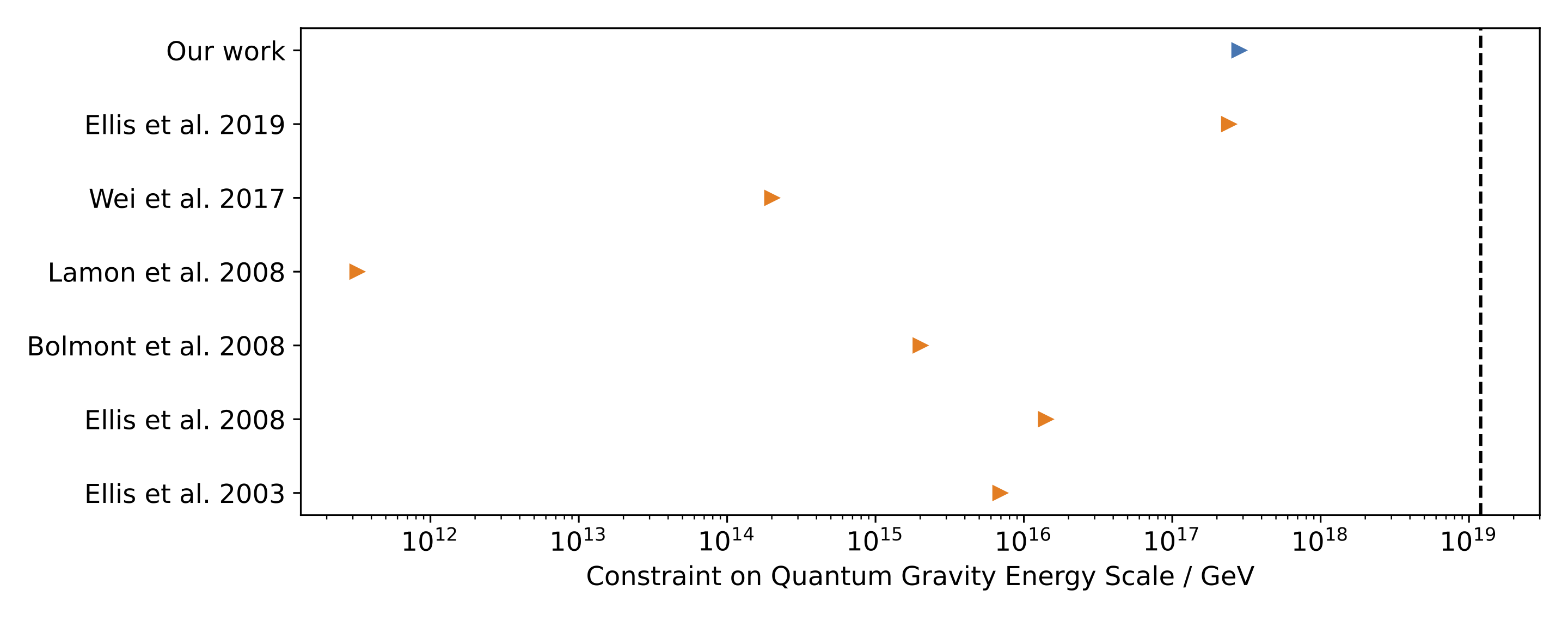
\(\ell_{\rm QG} &lt; 5.3 \times 10^{-18} \, h \, {\rm \, GeV^{-1}}\) at 95% confidence <sup id="fnref:2" role="doc-noteref"><a href="#fn:2" class="footnote" rel="footnote">2</a></sup>. As shown in Figure 2,
the quantum gravity constraint is the tightest from time delay studies which consider multiple Gamma Ray Bursts, and the constraint
on \(m_\gamma\), although weaker than from using radio data, provides an independent constraint which is less
sensitive to the effects of dispersion by electrons. We also place upper limits on an energy dependence of
\(\gamma\) of \(\Delta \gamma &lt; 2.1 \times 10^{-15}\) at \(1 \sigma\) confidence between photon energies of
\(25 {\rm \, keV}\) and \(325 {\rm \, keV}\) <sup id="fnref:3" role="doc-noteref"><a href="#fn:3" class="footnote" rel="footnote">3</a></sup>. These constraints are 40 times tighter than literature results,
illustrating the benefits of using complete mass distributions when studying non-local relativistic effects
such as time delays.</p>

<p>So what can we say about quantum gravity, the photon mass and the equivalence principle? Through the use of
simulation based, Bayesian statistical forward-modelling techniques and the BORG algorithm, we have produced
some of the tightest constraints on these theories to date, and have demonstrated that the results are robust
to how one models other astrophysical and observational contributions to the observed signal. It is expected
that \(\ell_{\rm QG}\) should be near the Planck length, which is approximately two orders of magnitude smaller
than we are currently sensitive to, so we are yet to probe this. It is expected that detecting Gamma Ray Bursts at
\(&gt;100 {\rm \, GeV}\) should be routine in the future; with more, higher energy measurements one should begin to
probe this energy scale, so there is the tantalising possibility of making the first detection of quantum gravity
as these limits approach the Planck scale in the near future.</p>

<p><img src="/assets/posts/quantum_gravity/qg_constraint_comparison.png" alt="Quantum gravity constraints compared to the literature" />
<em>Lower limits on the quantum gravity energy scale (\(1 / \ell_{\rm QG}\)) from time delay studies which use multiple astrophysical sources. Our work provides the tightest constraint to date. The dashed vertical line is the Planck energy, and it is expected that the quantum gravity energy scale has approximately this value.</em></p>

<div class="footnotes" role="doc-endnotes">
  <ol>
    <li id="fn:1" role="doc-endnote">
      <p>G. Lavaux, J. Jasche &amp; F. Leclercq 2019, ``Systematic-free inference of the cosmic matter density field from SDSS3-BOSS data’’, <a href="https://arxiv.org/abs/1909.06396">arxiv 1909.06396</a> ![arxiv] <a href="#fnref:1" class="reversefootnote" role="doc-backlink">&#8617;</a></p>
    </li>
    <li id="fn:2" role="doc-endnote">
      <p>D.J. Bartlett, H. Desmond, P.G. Ferreira &amp; J. Jasche 2021, ``Constraints on quantum gravity and the photon mass from gamma ray bursts’’, PRD accepted, <a href="https://arxiv.org/abs/2109.07850">arxiv 2109.07850</a> ![arxiv] <a href="#fnref:2" class="reversefootnote" role="doc-backlink">&#8617;</a></p>
    </li>
    <li id="fn:3" role="doc-endnote">
      <p>D.J. Bartlett, D. Bergsdal, H. Desmond, P.G. Ferreira &amp; J. Jasche 2021, ``Constraints on equivalence principle violation from gamma ray bursts’’, <a href="https://doi.org/10.1103/PhysRevD.104.084025">PRD 104, 084025</a> ![journal], <a href="https://arxiv.org/abs/2106.15290">arxiv 2106.15290</a> ![arxiv] <a href="#fnref:3" class="reversefootnote" role="doc-backlink">&#8617;</a></p>
    </li>
  </ol>
</div>]]></content><author><name>D. Bartlett</name></author><category term="method" /><category term="observations" /><summary type="html"><![CDATA[High energy astrophysical transients at cosmological distances allow us to test the fundamental assumptions of the standard models of cosmology and particle physics, such as the Weak Equivalence Principle, Lorentz Invariance or the massless nature of the photon. A violation of any of these would result in energy-dependent arrival times for photons from distant sources. We forward model these time delays for gamma ray bursts using the BORG SDSS-III/BOSS reconstruction and compare to data to constrain the quantum gravity energy scale, the mass of the photon, and violations of the Weak Equivalence Principle.]]></summary></entry></feed>